If you compare Happy Oyster and Runway as though they are the same product with different branding, the decision gets muddy fast. The public material suggests they are solving adjacent but not identical problems. Runway, at least in its current Gen-4 and Gen-4.5 positioning, is built around controllable clip generation that fits modern media production. Happy Oyster is being introduced by Alibaba ATH as a real-time world creation and interaction product with two explicit modes, Wandering and Directing.
This piece is based on public information checked on April 23, 2026, including Alibaba's official HappyOyster announcement, the live happyoyster.cn interface text, Runway's official Gen-4 video documentation, and the official Gen-4 research page. This is not a paid bench test.
If you want the broader product context first, start from the Happy Oyster home page, then come back to this comparison.
The Shortest Honest Version
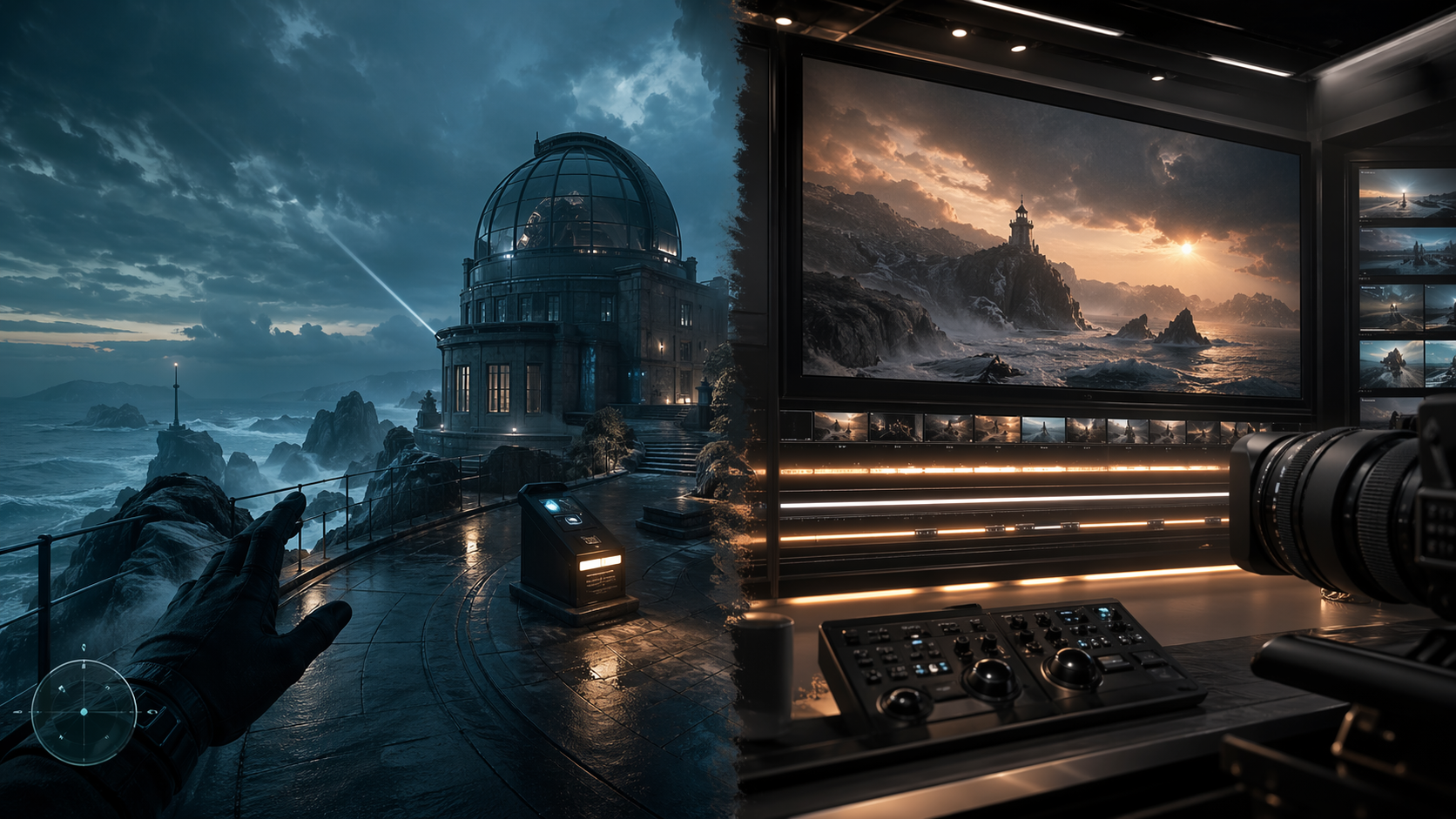
Runway looks like the safer buy when your team already knows it needs short, polished, reference-driven video output for a production pipeline. Happy Oyster becomes more interesting when the team is not only making a clip, but trying to move through a coherent place, steer a scene as it unfolds, or test a world before the final shot language is locked.
| If you mostly need... | Better fit | Why |
|---|---|---|
| controllable short-form clips for ads, social, or VFX-adjacent work | Runway | Its public material is centered on controllable generation that sits beside live action, animation, and VFX workflows. |
| a persistent environment you can explore or direct inside | Happy Oyster | Its official positioning is real-time world creation and interaction rather than a simple prompt-to-clip loop. |
| consistent characters, locations, or objects built from references | Runway | Gen-4 explicitly emphasizes reference-based consistency across scenes and perspectives. |
| first-person or third-person traversal and long directed scene continuity | Happy Oyster | Alibaba's public description and live UI point to navigation and longer-form directed world behavior. |
| the lower-risk choice for a team buying today | Runway | Happy Oyster is still presented through an Early Access gate, which changes the access equation immediately. |
The Real Difference Is What The Product Thinks A “Video” Is
Runway's official language still reads like a media-production tool. The Gen-4 documentation calls it “fast, controllable and flexible video generation” that can sit beside live action, animation, and VFX. The Gen-4 research material leans heavily on consistency across characters, locations, objects, styles, and perspectives. In other words, Runway is trying to make the shot pipeline more controllable.
Happy Oyster is framed differently. Alibaba's announcement describes it as a world model product for “real-time world creation and interaction.” Its public explanation of Wandering and Directing is not just a feature split. It signals that the product wants users to either discover a place or steer a scene in that place while it is happening. That sounds subtle until you are actually choosing a workflow. One product is primarily clip-first. The other is clearly world-first.
That is why the comparison should not begin with raw quality claims. It should begin with intent. Are you buying a tool to render a shot, or are you buying a tool to work out space, continuity, and directional control before the shot is fully defined?
Runway Is Stronger When The Work Is Already Editorial
If your team already lives in a shot-based production rhythm, Runway's public positioning is easier to map onto daily work. Reference-driven character and location consistency matter a lot when you are building campaigns, product films, fashion pieces, stylized promos, or mixed workflows that sit near compositing and editorial review.
The practical advantage is not only quality. It is that Runway's public docs already read like production instructions. They talk about references, prompting, and how the model behaves when you want repeatable visual identity. That gives teams a clearer operational starting point.
This is especially useful when the brief already exists. If the creative director has approved the look, the character, the mood board, and the framing language, then a clip generator with strong reference logic is exactly what you want. You are not asking the tool to invent a world. You are asking it to execute within one.
Happy Oyster Is More Interesting When The Scene Has To Behave Like A Place
Happy Oyster is easier to underestimate if you read it as just another AI video generator. The public material points to something more specific: live world interaction, real-time instruction updates, Wandering, Directing, first-person and third-person choices, and up to three minutes of continuous 720p footage in Directing mode.
That combination matters most when the value of the output is upstream from final delivery. Think previs, world exploration, game concept testing, interactive story blocking, environment review, or any creative meeting where the real question is not “is this final?” but “does this place and camera logic make sense yet?”
Runway can absolutely support atmosphere and control. But the public story around Happy Oyster is that the user can remain inside the generative event, not only queue it and wait. That is a different creative posture. It favors teams that want to probe an environment rather than simply render a clip from it.
Which One Should A Serious Team Actually Pick?
If you are a marketing team, a branded-content team, or a studio that already has a shot list and needs reliable short-form output, Runway is the more straightforward buy from the public information alone. It is easier to evaluate, easier to place in an existing review stack, and easier to justify if the workflow is already editorial.
If you are a previs team, a game concept team, or a creative lab trying to decide whether world-model interaction can reduce iteration time, Happy Oyster is the more differentiated bet. It is still earlier, and that matters. But it is earlier in a direction that may actually matter to teams working on space and continuity rather than just clip aesthetics.
That is the cleanest way to think about this comparison. Runway is the safer choice when you need a controllable clip engine. Happy Oyster is the more interesting choice when you need a world workflow.