Happy Oyster and Pika should not really be judged by the same emotional standard. Pika's public surface is fast, playful, feature-rich, and unapologetically creator-facing. Happy Oyster's public story is narrower and more serious: real-time world creation, interaction, Wandering, Directing, and early-access world-model experimentation.
This article is based on public information checked on April 23, 2026, including Alibaba's official HappyOyster announcement, the live happyoyster.cn UI text, Pika's official pricing page, and the official Pikaformance page. This is a public-material comparison, not a paid test.
If you want the broader product context first, start from the Happy Oyster home page, then come back to this comparison.
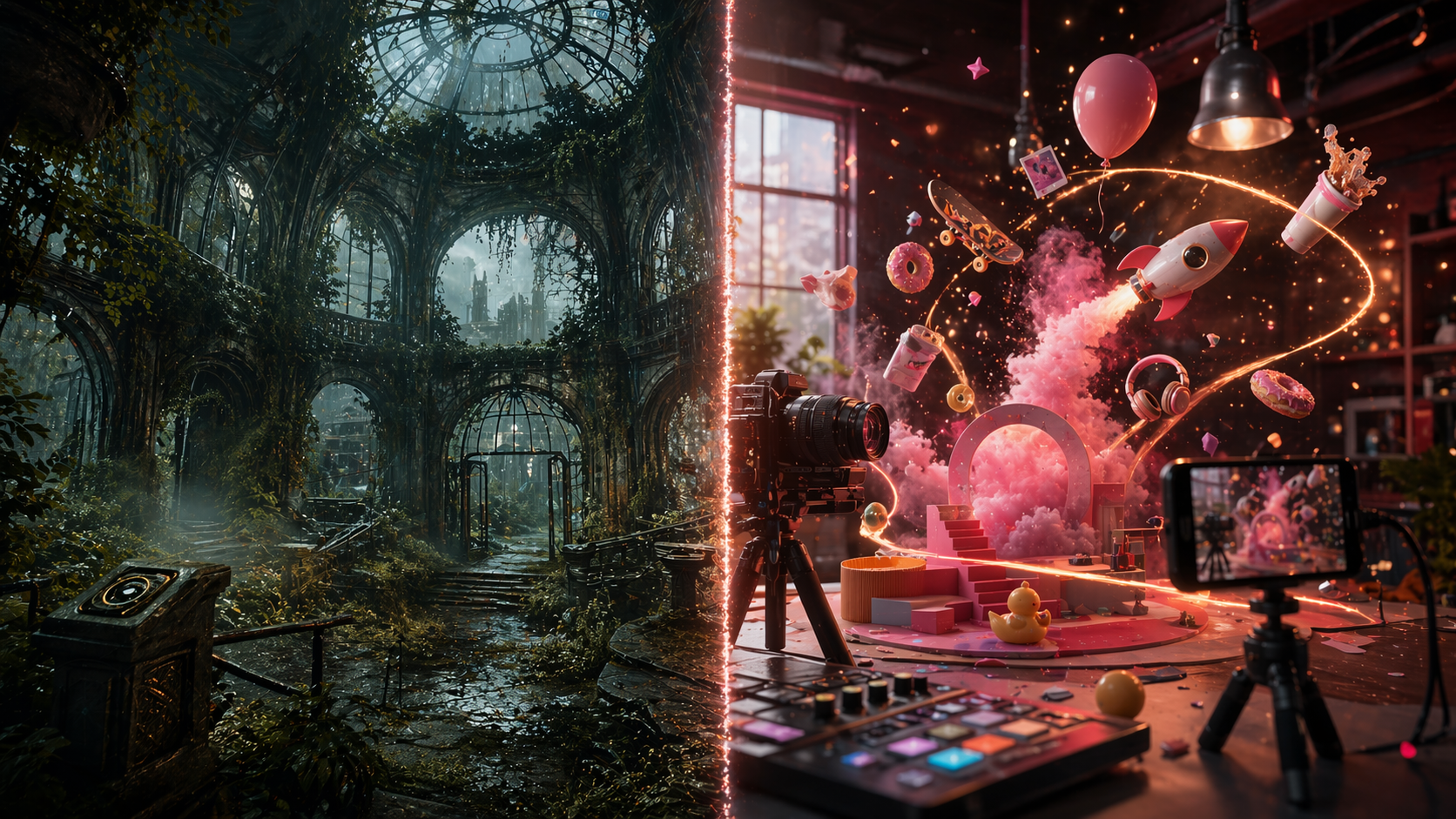
The Fast Answer
Pika looks like the better fit when the job is short-form creator content, playful transformations, image-driven edits, or fast effect-heavy experimentation. Happy Oyster looks better when the job is to understand or direct a coherent place over time.
| If you mostly need... | Better fit | Why |
|---|---|---|
| playful short-form transformation features | Pika | Its public product surface leans into Pikaffects, Pikascenes, Pikaswaps, Pikatwists, and Pikadditions. |
| a place that stays meaningful as the camera moves | Happy Oyster | Its public positioning is about world interaction rather than effect modules. |
| fast creator-facing experiments and social content | Pika | Even the public language around Pikaformance emphasizes speed, expression, and audio-driven play. |
| previs, environment exploration, or interactive scene blocking | Happy Oyster | Its public capability story is much closer to world-model usage than creator-effects usage. |
| a tool built around editing hooks and packaged generation modes | Pika | The public pricing and feature layout are modular and creator-product oriented. |
Pika Feels Like A Creator Toy Box On Purpose
That is not an insult. It is actually the point of the product. Pika's public pages are full of named features: Pika 2.5, Pikaformance, Pikaframes, Pikascenes, Pikadditions, Pikaswaps, Pikatwists, and Pikaffects. That naming scheme tells you exactly how the company wants people to think about the tool. It is meant to be approachable, remixable, and immediately usable for creators who want to do something punchy without first adopting a more complex world workflow.
The Pikaformance page makes that even clearer. It talks about hyper-real expressions synced to sound and near real-time generation speed. That is not the language of previs or spatial reasoning. It is the language of creator momentum.
If you need social-ready motion, quick edits, humorous transformations, stylized inserts, or a fast way to turn a visual idea into something shareable, Pika makes obvious sense. Its public interface reads like a set of well-packaged creative moves.
Happy Oyster Is Not Trying To Win That Game
Happy Oyster's public story is different enough that using the same evaluation criteria will create bad decisions. Alibaba's announcement emphasizes open-ended world creation and interaction. The live interface puts Wandering and Directing at the center. The product appears to care less about giving you a menu of flashy mutation modes and more about whether a world can be created, explored, and directed in real time.
That difference matters because it changes what counts as a good result. In Pika, a “good result” may simply be a compelling effect, a fun transformation, or a creator-friendly moment that lands quickly. In Happy Oyster, a good result is more likely to be a space that holds together, a camera path that makes sense, or a scene that remains controllable as it unfolds.
Those are not competing strengths. They are different creative priorities.
One Is Better For Play, The Other Is Better For Probe Work
Pika is easier to love quickly. The public features are concrete and legible, and the product clearly wants to help people make short, surprising, editable video artifacts. That is useful, especially if the goal is output velocity and variation.
Happy Oyster is more interesting when the work is diagnostic. You are probing an environment, testing how a world behaves, or deciding whether a scene can support a stronger spatial idea. That is less instantly gratifying, but often more valuable for film planning, game concepting, immersive media, and other upstream creative work.
This is why teams sometimes make the wrong comparison. They assume the more exciting first output is the more strategically useful tool. That is often true for creator content. It is much less true for spatial planning.
So Which One Should You Actually Choose?
If your goal is fast social output, creative experiments, talking-image performance, playful motion edits, or a feature-rich creator playground, Pika is the cleaner pick from public evidence. It is obvious what it wants to help you do.
If your goal is to evaluate a world-model workflow, especially for previs, environment ideation, spatial continuity, or real-time direction, Happy Oyster is the more differentiated tool. It is not trying to be a toy box. It is trying to be a place engine.
That is why this comparison is easier than it first looks. Pick Pika when you want fast creative moves. Pick Happy Oyster when you want a world that can be tested, not just a clip that can be decorated.